Table of Contents
Think about the last time you got into a car, one of the first things you do is to connect your mobile device to the screen, creating a symbiotic connection between your device and the vehicle, with navigation, music, and messages woven into the dashboard like a second heartbeat.
These digital experiences have become just as critical as the mechanics that move the car. If navigation freezes or voice control misfires, it’s more than an inconvenience. It’s a distraction that affects safety and trust.
That’s why in-car infotainment testing is so important. It ensures that the app you ship to the world can stand the test of time across different devices, operating systems, and vehicle models.
And that’s where infotainment testing comes in.
What “Infotainment Testing” Really Means
Infotainment testing is all about verifying how the software inside the car interacts with the driver and the world around it. It’s where technology meets human experience, testing navigation, connectivity, media, and other digital touchpoints that keep the modern vehicle running smoothly.
But not every infotainment app runs the same way. There are three main types of experiences that automotive teams test today, and understanding the difference is key to designing a reliable validation strategy.
Mobile-Based Applications (Mounted Phone)
These are apps like Waze, Spotify, or Google Maps running directly on a smartphone. The driver mounts the phone, connects to Bluetooth, and interacts with the app interface while driving.
Testing here focuses on how the app behaves during real driving scenarios, for example, navigating from point A to point B, responding to turns, recalculations, voice prompts, and handling interruptions like calls, notifications, or changes in network quality.
Projected Applications (Android Auto and Apple CarPlay)
This is where the phone and the car work together. The app runs on the phone, but what the driver sees and interacts with appears on the car screen.
In this type of testing, the focus is on how the app behaves once it’s projected onto the dashboard display, whether the interface looks right, the buttons respond correctly, and everything functions smoothly through the car controls.
Embedded or Native In-Car Apps (Android Automotive OS)
This is where the industry is headed next. In these setups, the software runs directly inside the car’s operating system, no phone is needed.
This allows for deeper integration with the vehicle’s sensors and systems, but it also makes testing more complex. Teams must verify not just the app itself, but how it interacts with the car’s hardware and environment.
While most automakers are still moving toward this stage, Digital.ai is already preparing for it, building the foundation to support fully embedded app testing in the near future.
Why Infotainment Testing Matters Now
The automotive world is changing fast. As vehicles become more electric and software-driven, the line between “car” and “device” keeps fading.
Modern vehicles now ship with up to 100 million lines of software code, and that number is expected to climb dramatically in next-generation electric and autonomous vehicles. Software already accounts for a growing share of vehicle value, and the global automotive software and electronics market is projected to reach around $462 billion by 2030 (McKinsey & Company, 2023).
What used to be a handful of built-in features, radio, navigation and Bluetooth, is quickly becoming a full ecosystem of apps and digital services.
This shift brings new expectations. Drivers now expect the same responsiveness and reliability in their cars that they get on their smartphones.
That’s why validating these experiences has become so important. Infotainment testing isn’t just about checking if the app opens; it’s about ensuring every interaction feels safe, smooth, and distraction-free, because on the road, even small bugs can have real consequences.
Why Infotainment Testing Is Challenging
Testing in-car apps today is far from simple. Most teams still rely on local setups, connecting phones, cables, and vehicle head units in the lab to validate app behavior. While this approach works, it’s slow to scale.
Even with the right technical expertise, the challenge quickly becomes less about the hardware itself and more about coverage.
The number of combinations grows fast: different vehicles, OS versions, projections and screen sizes; all create variables that need to be tested.
Without a consistent environment, reproducing issues or running the same tests repeatedly becomes difficult. And without that consistency, it’s harder to analyze results, identify patterns, or spot recurring themes across builds and releases.
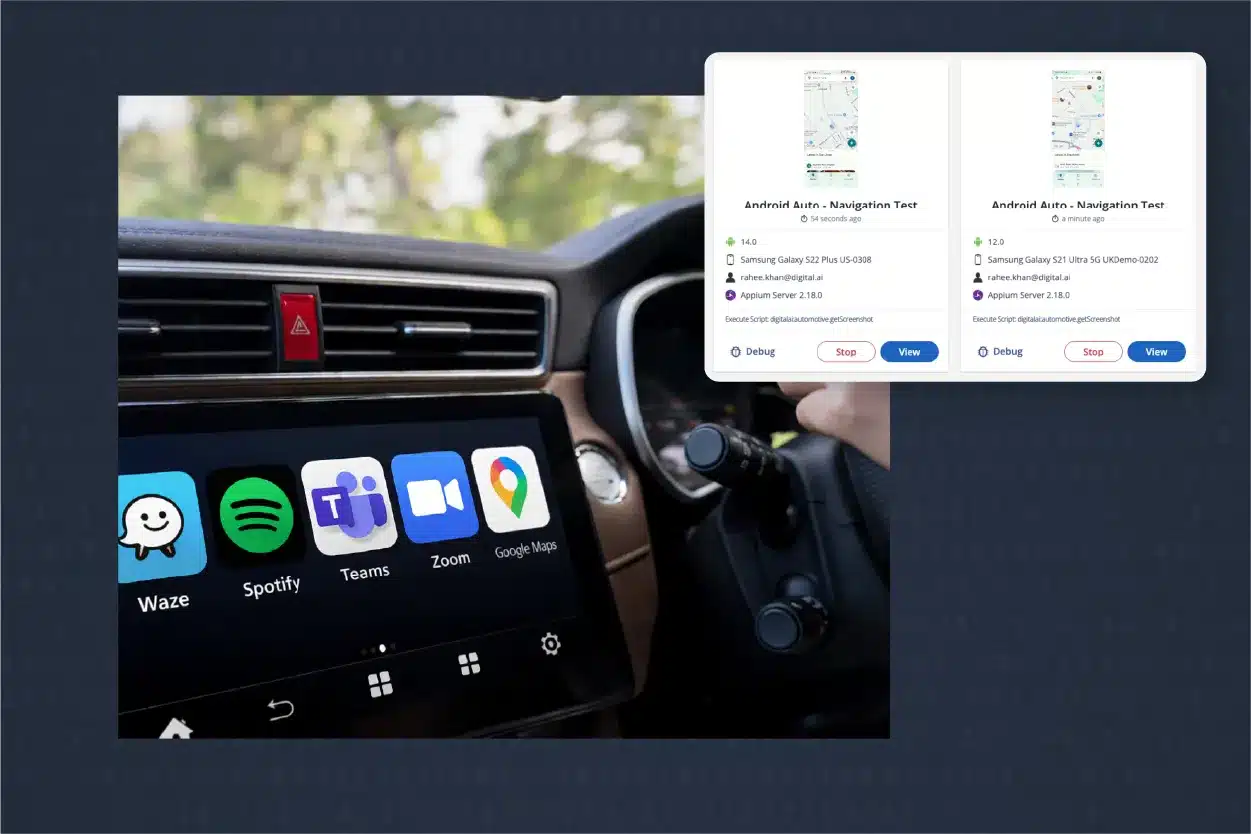
This is where a platform like Digital.ai Testing makes a difference. Instead of maintaining physical rigs, teams can access a secure device farm with preconfigured environments for Android Auto, Android Automotive, and Apple CarPlay. You get the flexibility of real hardware, the repeatability of automation, and the scale needed to test across many device combinations — all without the setup hassle.
How Digital.ai Simplifies It
Digital.ai Testing makes in-car app validation easier and faster by moving it to the cloud. From a single, browser-based lab, teams can:
- Test Android Auto, Android Automotive, and Apple CarPlay apps in a single secure environment.
- Run Appium-based automation to simulate real driver interactions.
- Capture logs full-session recordings for quick troubleshooting.
- Integrate testing directly into CI/CD pipelines for continuous validation.
- Leverage AI-powered insights to identify recurring issues and failure patterns.
No vehicles. No cables. No bottlenecks — just consistent, scalable validation.
Driving Toward the Future
As cars become more software-defined, testing can’t stay stuck in the past. Infotainment testing is how teams make sure every digital moment in the car, from navigation to music, feels effortless and safe.
At Digital.ai, we’re helping automotive teams test smarter today while laying out the foundation for tomorrow’s fully connected, software-driven vehicles.
By simplifying how infotainment apps are validated, teams can move faster, deliver safer driver experiences, and stay competitive in an industry where software evolution shows no signs of slowing down.

Author
Rahee Khan, Senior Product Marketing Manager
Ready to simplify your in-car app validation? Explore Digital.ai Testing and see how you can test smarter & safer.
Explore
What's New In The World of Digital.ai

Performance Testing for Mobile: Beyond Just “Is It Fast?”
A comprehensive guide to battery drain, memory leaks, network efficiency,…

The Devs Guide to Synthetic Data Generation and Self-Cleaning Test Environments
In 2026, the biggest hurdle in shipping software isn’t how…

Escalations Aren’t Noise: They’re Your Most Honest Quality Signal
Most companies insist they care about product quality. Yet many…