Published: April 10, 2026
The Myth of Automation Lock-In: Migrating Quantum Without Rewrites

While talking with so many enterprise QA teams as a part of my job, one thing I have realized is that they usually don’t struggle with creating tests anymore—they struggle with keeping them relevant, scalable, and portable.
And yet, when it comes to changing testing platforms, most teams hesitate, because of a deeply ingrained fear:
“We’ll have to rewrite all our tests.”
It’s one of the most common—and costly—assumptions teams make when considering a change in their test automation platform.
Over time, automation suites become deeply tied to execution environments through layers of configuration, integrations, and perceived dependencies. What starts as a flexible system gradually turns into something that feels difficult—if not risky—to change.
And so, teams stay where they are.
Not because they lack better options, but because the perceived cost of moving outweighs the value of evolving.
But here’s the reality: in many modern automation setups, that cost is often overestimated.
If you’re using Perfecto Quantum, that assumption deserves a closer look. Because in reality, you may already be far closer to portability than you think.
The Real Problem: Platform Lock-In vs Test Asset Portability
Over time, automation suites become valuable assets:
- Hundreds (or thousands) of test cases
- Business-critical flows encoded into scripts
- Deep integration with CI/CD pipelines
The fear of losing this investment often leads to tool stagnation—teams stick with what they have, even when better alternatives exist.
But this fear is often rooted in a misconception:
That your test scripts are tightly bound to your execution platform.
With Quantum, that’s not entirely true. And this is where understanding what sits underneath Quantum becomes important.
What Quantum Actually Is (and Why That Matters)
At a glance, Perfecto Quantum feels like a complete, tightly integrated solution.
But under the hood, it’s built on top of the open source QMetry Automation Framework (QAF) – a detail that’s easy to overlook, but has significant implications.
Because Quantum is layered on top of QAF, your tests are not inherently tied to a single execution backend. They are:
- Framework-driven and not platform-hardcoded
- Configuration-based rather than environment-bound
- Built on standardized automation engines
When you look at any quantum framework project, you will see:
- A BDD-style abstraction layer
- Integration with cloud execution
- Simplified test creation and execution workflows
But underneath all of this:
- Test steps map to QAF constructs
- Execution relies on Selenium/Appium drivers
- Configuration drives environment behaviour
This means your test suite already has a level of decoupling that many teams spend years trying to achieve.
And once you recognize that, it changes how you think about portability entirely.
A helpful way to look at this is to break your automation into layers:
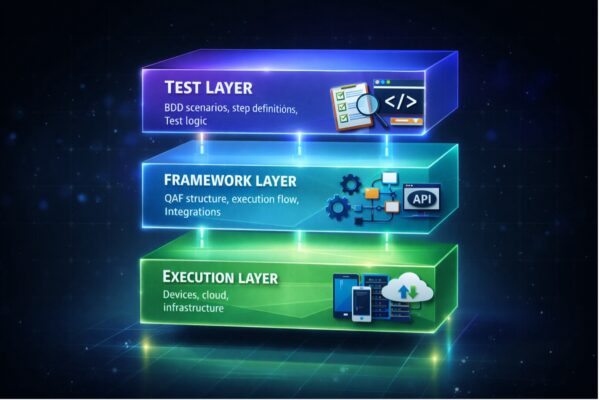
Most teams focus heavily on the top layer (test cases) and the bottom layer (devices/cloud).
But the framework layer is what creates portability.
And since Quantum sits on QAF, that middle layer is already doing a lot of heavy lifting for you.
Migration Reality: What Actually Changes?
When moving from Perfecto to Digital.ai Testing, you are not rebuilding your automation stack.
You are simply changing the execution layer. This distinction makes the migration far less dramatic than most teams expect.
| What Stays the Same | What Changes |
| • Test scripts (BDD or Java-based) • Step definitions • Page objects • Test logic and assertions • Overall framework structure |
• Execution endpoint (cloud URL) • Desired capabilities / device configuration • Authentication mechanism • Reporting integration (optional) • Custom Perfecto Commands (if any) |
That’s it.
Swapping the Execution Layer
At a conceptual level, the transition looks like this:
The key shift is subtle but powerful:
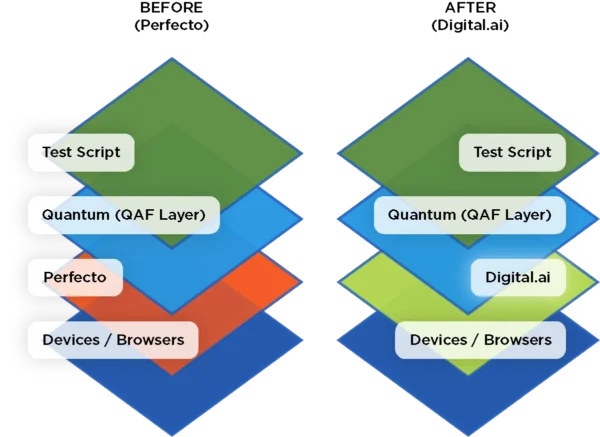
You are not replacing your framework—you are just swapping its execution layer.
What “Minimal Changes” Actually Means
“Minimal changes” is often used loosely. Let’s break it down into tangible actions.
1. Update Remote Server & Authentication Configuration
| Before (Perfecto) | After (Digital.ai) |
remote.server=perfecto_url |
remote.server=digitalai_url |
2. Capability Mapping
Adjust:
- Device names
- OS versions
- Platform-specific capabilities
Most of this is configuration-level and does not impact test logic.
3. Reporting Adjustments (Optional)
If you’re using built-in reporting tied to Perfecto:
- You may switch to Digital.ai reporting dashboards
- Or integrate with your existing reporting pipeline
Common Gotchas to Watch For
To keep things realistic, there are a few areas to validate:
- Custom commands tied specifically to Perfecto APIs
- Hardcoded capabilities in test code
- Device naming assumptions
- Network or security configurations
These are typically edge cases—not blockers—but worth identifying early.
Why Teams Are Making This Move
While migration is often driven by business or platform considerations, teams also look for:
- Broader and more flexible device coverage
- Alignment with modern DevOps and CI/CD workflows
- Improved observability into test execution
- Smarter insights into failures and stability
But beyond features, there’s a more strategic reason.
The Bigger Shift: Decoupling Test Assets from Execution
The real takeaway here isn’t about one platform vs another.
It’s about a mindset shift:
Test automation should be portable by design.
When your:
- Test logic
- Framework
- Execution layer
are loosely coupled, you gain:
- Freedom to evolve your tooling
- Reduced vendor lock-in
- Faster adaptation to new technologies
Quantum—because of its QAF foundation—already puts you on that path.
Final Thoughts
If you’re using Quantum today, you’re not locked into a single ecosystem.
You’ve already made an architectural choice that favours reuse, abstraction, and portability.
Which leads to a different kind of question:
Not “Can we migrate?”
But “Why aren’t we leveraging the flexibility we already have?”
If you approach migration as an execution-layer shift—not a framework rewrite—you’ll find that the path forward is far simpler than it first appears.
You Might Also Like

Apple’s First Foldable Is Here. Is Your App Ready for It?
Apple’s first foldable iPhone, iPhone Duo, introduces something fundamentally different…

More Tests Are Easy. Managing Them Is Getting Harder.
Test automation keeps growing. Teams are building more Appium tests,…
